_edited.png)
_edited.png)


Seller Concessions vs. Price Reduction: Which Can Save Houston Buyers More?

When buying a home, negotiating the price is usually one of the first things buyers think about. But a lower purchase price is not always the best deal.
In today’s Houston market, buyers may have another option: asking the seller for concessions. Depending on the transaction and loan program, seller concessions can help cover certain closing costs or contribute toward an interest rate buydown.
So which is better: a $10,000 price reduction or $10,000 in seller concessions?
The answer depends on your financial goals.

What Is a Seller Concession?
A seller concession is an amount the seller agrees to contribute toward eligible buyer costs as part of the purchase agreement.
Depending on the loan and lender guidelines, concessions may help with certain closing costs, prepaid expenses, title or lender charges, and potentially an interest rate buydown. They generally cannot simply be used as a replacement for your required down payment.
For buyers who are trying to preserve cash, this can be valuable.
For example, if you are purchasing a $350,000 home and negotiating $10,000 toward eligible closing costs, you could potentially reduce the amount of cash you need to bring to closing.
That can leave more money available for moving expenses, furniture, emergency savings, or future repairs.
What Happens With a Price Reduction?
A price reduction lowers the actual purchase price of the home.
That can reduce the amount you finance and, as a result, may reduce your monthly principal and interest payment.
But the difference may be smaller than many buyers expect.
A $10,000 reduction on a $400,000 home does not mean your monthly payment drops by $10,000. The savings are spread across the mortgage over time.
That is why it is important to compare the actual numbers instead of assuming the larger-looking discount is automatically better.
Which One Saves You More?
Consider two buyers looking at the same $350,000 home.
Buyer A negotiates a $10,000 price reduction.
Buyer B negotiates $10,000 in seller concessions.
Buyer A may benefit from a slightly lower loan amount and lower monthly principal and interest.
Buyer B may keep the purchase price higher but use the concession to reduce eligible closing costs or potentially buy down the interest rate.
According to recent Houston buyer guidance, seller concessions can provide a much larger reduction in cash to close than a similarly sized price reduction, while a price reduction can provide a more direct monthly payment benefit.
Neither option automatically wins.
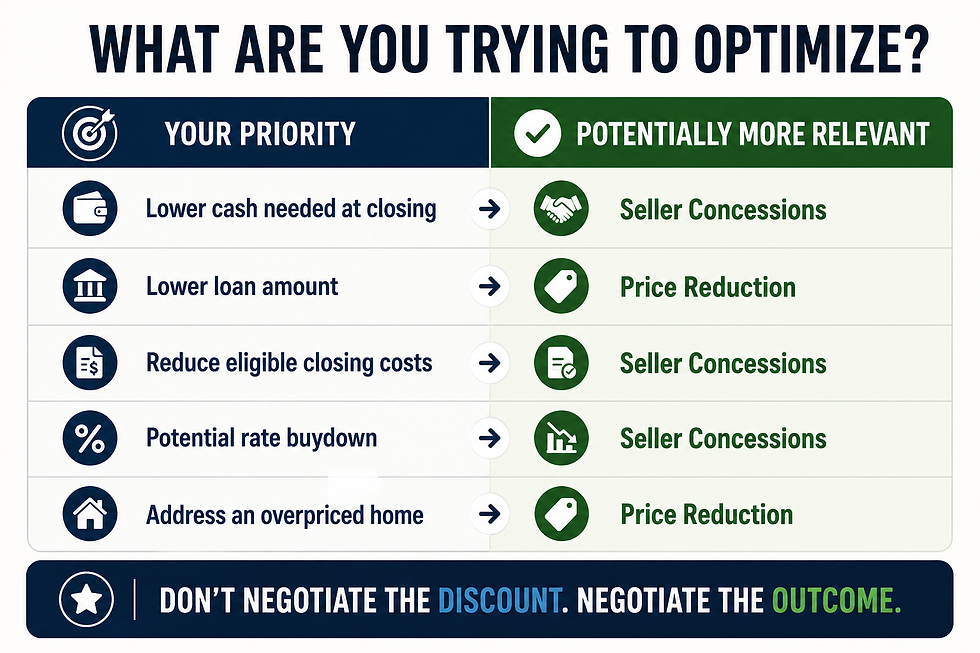
When Seller Concessions May Make More Sense
Seller concessions may be worth considering when cash is your biggest concern.
If you have enough income to afford the monthly payment but are trying to avoid draining your savings at closing, reducing your upfront costs can be more valuable than saving a relatively small amount each month.
Concessions can also be useful when a rate buydown makes sense for your financing strategy.
When a Price Reduction May Be Better
A price reduction may make more sense when your primary goal is lowering the amount you finance and reducing your long-term monthly payment.
It can also be the better strategy when the home is simply overpriced compared with comparable properties.
A concession does not fix an overpriced house.
If the numbers do not support the purchase price, you still need to address the price itself.

The Better Question Is Not “Which Is Better?”
The better question is:
Which option gives you the strongest overall deal?
Before choosing between a price reduction and seller concessions, look at your cash to close, monthly payment, interest rate, loan program, property taxes, insurance, appraisal, and long-term plans.
This is where strategy matters.
The cheapest purchase price is not always the transaction that costs you the least.
And the largest seller concession is not automatically the best offer either.
Your Realtor should help you compare the numbers and structure the offer around your goals.
Strategy before shopping. The best deal is the one that works for your finances today and your plans tomorrow.



Comments